Increasingly, customers are requesting odour abatement support for cooked product facilities, rather than purely poultry processing sites. This requires a different approach for the more demanding odours produced, due to the elevated temperatures associated with the ovens and from the added challenge of removing the fats, greases and oils from the fumes.
The fats, greases and oils present a challenge in that they accumulate and block the scrubber internals, pipework and equipment, resulting in significant reduction in scrubbing efficiency. Therefore, on this project, Parsons engineered a bespoke design to capture and remove the fats, oils, and greases from the gas stream in a pre-scrubber before the odour treatment second stage, ensuring high efficiency scrubbing and compliance with the site odour permit in accordance with the Environment Agency requirements.
Our most recent system was required to treat an extracted air volume of almost 30,000 m³/h, achieving an odour reduction in excess of 99%.
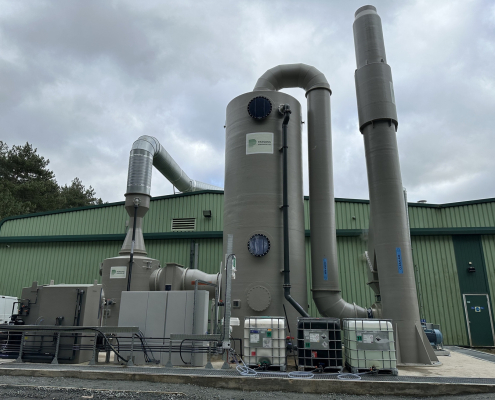
Parsons designed and supplied a bespoke two-stage scrubbing system tailored to the specific demands of the process.
Stage 1 – Gas Cooling: The inlet gas stream first passes through our first scrubber, which rapidly cools the high-temperature fumes to allow further treatment, whilst simultaneously removing particulates, grease and fats and oils. The gas cooling increases the efficiency of the odour scrubbing in Stage 2 since odorous gases will be more soluble at lower temperatures. The odorous gases once absorbed react exothermically with the scrubber reagent, thus lower temperatures enhance the scrubbing efficiency.
The Stage 1 scrubber also functioned as an odour pre-scrubber as the bleed from Stage 2 was fed into Stage 1, thus achieving some of the odour scrubbing in the first stage, and overall improving the odour removal efficiency of the scrubber system.
Stage 2 – Chemical Scrubbing: The cooled and separated gas now passes into a packed column scrubber for final odour treatment. A dilute solution of Sodium Hypochlorite (NaOCl) and Sodium Hydroxide/ Caustic Soda (NaOH) is recirculated under fully automatic pH and Redox (ORP) control. The ORP parameter is a measure of the oxidation-reduction potential of the scrubber liquor, a key parameter determining the effectiveness of the oxidation of the odours by the liquor. The chemical reagent absorbs odorous species from the gas stream and destroys them through oxidation, preventing any re-emission of odour into the gas phase. The automatic chemical dosing system ensures the reagent is maintained at optimal concentration at all times, maximising scrubber performance and ensuring consistent compliance.
The required equipment was designed by Parsons in-house Chemical Engineers and installed by our in-house Installation Technicians. On completion the system was commissioned by our engineers, who then trained the client’s maintenance teams, shared a detailed set of operating instructions and handed over control of the system to the client on time. Parsons provide a servicing agreement, attending site monthly to service the equipment and complete preventative maintenance, and are on standby to offer a next day breakdown service, to ensure compliance with Environmental Agency requirements.
Parsons have nearly 50 years’ operational experience in Gas Scrubber and Odour Abatement system design, manufacture, installation and servicing, operating across a wide range of industries throughout the UK and internationally. We welcome the opportunity to discuss any odour abatement or fume scrubbing requirements you may have.
Contact us today to find out more.