Oxides of Nitrogen (NOx) present a particularly demanding scrubbing challenge. Unlike Hydrogen Chloride (HCl) or Hydrogen Fluoride (HF) gases which are readily soluble and relatively straightforward to absorb into aqueous scrubbing liquor. When NO₂ is absorbed and dissolves into water, it is hydrolysed and undergoes a disproportionation reaction where the nitrogen atoms are both oxidised and reduced to form HNO3 and Nitrous Acid (HNO2). The Nitrous Acid formed is highly unstable and decomposes to form Nitric Oxide/ Nitrogen Monoxide (NO) and Nitric Acid. The NO is released back into the gas stream, and readily re-oxidises in the gas phase back to NO₂. This creates an ongoing cycle that standard single-stage scrubbing cannot adequately break. Achieving high removal efficiencies therefore requires a purpose-designed multi-stage approach.
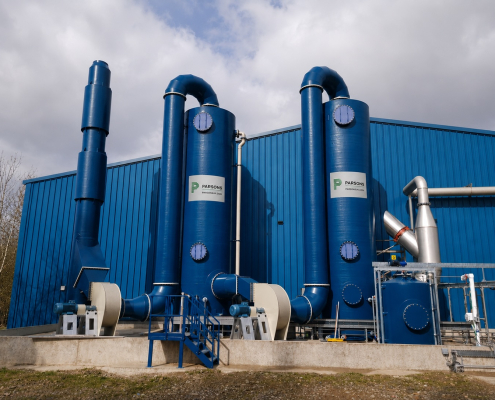
Parsons have developed specialist technologies specifically for Nitric Acid fume scrubbing at high concentrations. Most recently, Parsons were commissioned by a specialist combustion engineering company to design, manufacture, install and commission a two-stage packed column scrubbing system to treat fumes from a high-temperature industrial furnace process. The furnace process utilised Nitric Acid and thus produced NOx fumes (NO2 and NO) at the high furnace temperatures.
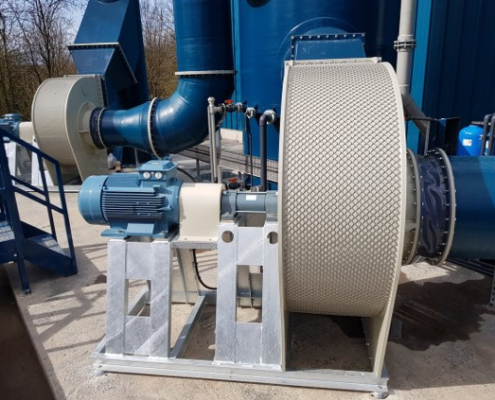
The process presented two significant challenges: the high concentration of NOx fumes in the gas stream, and an elevated inlet gas temperature of 60°C from the furnace discharge. The system was required to treat an air flow of 22,000 m³/h, and to generate sufficient static pressure, of up to 4,000 Pa, to overcome the resistance of the multi-stage scrubbing train. Standard fan technology is not suited to this duty; requiring the fans to be both chemically resistant and capable of generating high static pressures in a hot, corrosive environment.
Parsons designed and supplied a bespoke two-stage packed column scrubbing system tailored to the specific demands of the process.
Stage 1 – Nitric Acid Recirculation: The first packed column scrubber recirculates a solution of Nitric Acid. The Nitric Acid reacts with Nitric Oxide to form Nitrous Acid, which is partially stabilised in the presence of Nitric Acid, in accordance with Le Châtelier’s principle. Thus the NO is removed from the gas stream, leaving the NO2 which is absorbed in the alkaline Stage 2 scrubber.
As the scrubber operates, the acid concentrates and can typically be returned for use in the upstream process, reducing chemical waste and improving overall process efficiency as well as minimising the consumption of chemicals in the scrubbing process.
Stage 2 – Alkali Scrubbing: The partially treated gas passes into a second packed column scrubber recirculating Sodium Hydroxide/ Caustic Soda (NaOH) under automatic pH control, providing final removal of residual Oxides of Nitrogen (NO2) before discharge to the atmosphere. The absorption and reaction of the NO2 in the alkaline solution produces sodium nitrite (NaNO2) and sodium nitrate (NaNO3) as the reaction products.
For both scrubbing stages, absorption with reaction ensures a steep concentration gradient for the NOx between the gas and liquid phases, thus the driving force for mass transfer from the gas phase into the liquid phase is maintained, resulting in optimal scrubber performance at all times.
As the scrubbing process progresses, reaction products (such as salts) are continuously formed, and are thus bled from the scrubber sumps to prevent excess accumulation which would cause scrubbing efficiency reduction. However, for this application, in order to meet the liquid pH discharge limits, the Stage 1 and Stage 2 scrubber bleeds needed to be neutralised to achieve the required discharge pH.
Parsons therefore designed, manufactured, installed and commissioned a bespoke acid-base neutralisation system, thus ensuring environmentally compliant liquid discharge alongside compliant gas emissions from the scrubber system into the atmosphere. The neutralisation system utilised the bleeds from Stage 1 and Stage 2 only, without requiring external dosing of acid or base. This neutralisation regime optimised chemical consumption for the scrubber system.
Parsons also have experience of using Potassium Hydroxide (KOH) in systems where other acids are being processed, such as Hydrofluoric Acid (HF). The choice of scrubbing chemical is a function of the chemistry and solubility of the salts (reaction products).
Each stage is served by its own dedicated liquor recirculation system and extract fan. The fans were designed and manufactured in-house by Parsons, using robust and chemically resistant polypropylene plate and GRP. The complete fan and scrubber package was in turn manufactured, installed and commissioned by Parsons engineering and installation teams.
The system was tested on completion and demonstrated a reduction in inlet fume concentration from 500 ppm to less than 250 ppm permit limit, thus achieving compliance with discharge requirements.
Parsons have nearly 50 years’ operational experience in Gas Scrubber and Fume Abatement system design, manufacture, installation and servicing, operating across a wide range of industries throughout the UK and internationally. We welcome the opportunity to discuss any fume scrubbing or odour abatement requirements you may have.
Contact us today to find out more.